
Open to fellowships & full-time roles · 2026 · Oxford, UK
--:-- GMT
v4.0 · 30.04.26 · EN-GB
Grahm Gaydos
GTG_001 Oxford · 2026
35mm · ƒ/1.8
AI policy researcher · Oxford Internet Institute

I work on AI policy
at the layer where
promises get tested.

I'm Grahm Gaydos. AI and digital transformation policy lives or dies in the institutional layer beneath the press release—the procurement criteria, the assessment frameworks, the stakeholder negotiations that decide what gets bought, who builds it, and whether it actually works. That layer is where I thrive. I've done tool evaluation and governance design at Jefferson County, published research with the Westminster Foundation for Democracy, spoken at the UN, and I'm finishing an MSc at the Oxford Internet Institute on how federal procurement memoranda shape AI adoption.

500K+
Residents Served · JeffCo Emerging Technologies Team
3
Published Works
1
UN Floor address · ICT Working Group
2028
USA Triathlon Olympic Track
Frontier AI tool evaluation Governance frameworks that ship Policy briefs & reports Stakeholder interviews Mixed-methods research design Quantitative analysis · R · Stata Procurement assessment Translating tech to policy Frontier AI tool evaluation Governance frameworks that ship Policy briefs & reports Stakeholder interviews Mixed-methods research design Quantitative analysis · R · Stata Procurement assessment Translating tech to policy
03 — Selected work

A selection of my recent work.

Download CV
№ 01
2026

Procurement and Process: an interrupted time series analysis of federal AI contracting after the 2024 OMB AI procurement memoranda

Oxford Internet Institute · MSc thesis
In Progress
+

An interrupted time series analysis of US federal contracting data examining whether the 2024 Office of Management and Budget (OMB) AI procurement memoranda measurably shifted agency-level AI adoption.

Identifies AI-related contract actions across roughly 7,200 agency-months and tests for level shifts at the M-24-10 (March 2024) and M-24-18 (September 2024) intervention points. Distinguishes between extensive-margin (frequency) and intensive-margin (volume) responses — a distinction with direct implications for how administrative AI policy is read as a regulatory instrument. Full chart and methodology →

Methodology

Method
ITS · panel FE
Tools
R · Stata · fixest
Source
USAspending.gov
Submission
Jun 2026
Procurement Causal inference Federal data R Stata
№ 02
2026

From Pilot to Policy: why government AI pilots stagnate, and what that tells us about institutional capacity

AI for Policymaking · Essay
Research
+

An argument that the persistent failure of public-sector AI pilots to scale into deployment is not a technology problem or a funding problem — it is a structural feature of how the pilot apparatus itself is institutionally built. Pilots succeed because they are exempted from the procurement, governance, and accountability structures that deployment would have to operate within.

The same exemptions that make pilots succeed are the conditions that prevent them from progressing. Stagnation is the system working precisely as the institutional environment has forced it to.

Detail

Course
AI for Policymaking
Type
Argument essay
Anchors
Mikhaylov · Wirtz · Kattel
Public-sector AI Pilots Institutional capacity Procurement
№ 07
2026

Governed Opacity: the EU AI Act's unresolved tension between prohibiting and institutionalising information asymmetry

Law and the Internet · Coursework
Research
+

Argues that the EU AI Act draws no coherent conceptual line between harmful and productive information asymmetry — Article 5 prohibits certain forms of opacity outright, while Articles 57–63 institutionalise opacity as a precondition for innovation.

The Act's boundary between the two is not principled but procedural and distributive: it calibrates who benefits from informational asymmetry and on what terms, rather than resolving the underlying tension.

Detail

Course
Law and the Internet
Type
Argument essay
Anchors
Mayer-Schönberger · Zarra · Bradford
EU AI Act Information asymmetry Regulatory design
№ 03
2025

Jefferson County's first frontier-AI governance framework

Jefferson Co. · Colorado
Applied
+

Contributed to the design and adoption of the County's first governance framework for frontier AI models, establishing institutional procedures for evaluating, piloting, and scaling emerging technologies across departments serving over 500,000 residents.

Led qualitative stakeholder interviews with department leads across government divisions and synthesised findings to shape the framework's evaluation, pilot, and scale-up procedures.

Impact

Residents
500,000+
Status
Adopted
Team
Innovation & Emerging Tech
Dates
Jun – Oct 2025
Frontier AI Governance Local government Implementation
№ 04
2025

An 8-criterion structured assessment framework for AI tool procurement

Jefferson Co. · Colorado
Applied
+

Co-designed an 8-criterion structured assessment framework for evaluating frontier AI tools against procurement requirements, workflow constraints, governance risk, and political context. Combined qualitative evaluation with light quantitative scoring to reduce evaluator bias and produce a consistent evidence base for procurement decisions.

Used to assess frontier AI tools for County adoption; outputs informed leadership's technology decisions and were incorporated into the broader governance framework.

Detail

Criteria
8
Method
Mixed (qual + quant scoring)
Used in
Tool evaluation pilots
Year
2025
Tool evaluation Procurement Comparative scoring Methods
№ 05
2025

Five pilot proposals for departmental AI adoption

Jefferson Co. · Colorado
Applied
+

Authored five pilot proposals for the project management team evaluating frontier AI tools for departmental adoption. Each proposal assessed implementation feasibility, governance risk, and operational impact — translating abstract technology guidance into concrete pilot designs that the County could actually run.

Detail

Proposals
5
For
Project mgmt team
Assessed
Feasibility · risk · impact
Pilot design Frontier AI Implementation
№ 06
2025

The 2013 Healthcare.gov Launch & State Capacity in the Digital Age

Williams College · Senior thesis
Published
+

Mixed-methods study using qualitative and archival analysis of procurement documentation, government reports, and organisational case studies to trace how procurement failures upstream of the 2013 Healthcare.gov rollout determined delivery outcomes.

The argument: the launch crisis was a procurement crisis before it was a software crisis. Sets up the procurement-as-governance frame extended in the MSc thesis.

Detail

Method
Qualitative · archival
Programme
Political Science
GPA
3.83 · Dean's List
State capacity Procurement Healthcare.gov Case study
№ 08
2024

AI & Democracy: Landscape, Risks & Opportunities for the Democracy Support Sector

Westminster Foundation for Democracy
Published
+

Managed a 3-month research project from scoping through publication, delivering a 15,000-word policy report on AI and democracy promotion. Incorporated a literature review of 50+ sources, stakeholder insights, and a policy memo with recommendations now used to inform organisational strategy.

Developed a working definition of AI for the democracy support sector and translated it into a briefing deck presented to WFD staff and external partners, packaging complex policy research for varied audiences.

Detail

Length
15,000 words
Lit review
50+ sources
Published
Sept 2024
AI governance Democracy Practitioner brief International
№ 09
2024

AI & Electoral Integrity

Williams Class of 1945 World Fellowship
Published
+

Eight-week fellowship project on AI's impact on democratic practices and elections — synthesising primary sourcing, case studies, stakeholder interviews, and quantitative data collection. The report deliberately resists the genre's pull toward speculation; the goal was a usable baseline rather than scenario-building.

Detail

Fellowship
Class of 1945
Method
Mixed
Duration
8 weeks
Elections Empirical AI deployment
№ 10
2024

Digital Innovation and Governance: how states should respond to authority challenges from digital platforms

Oxford · Coursework
Research
+

A 5,000-word essay produced under tutorial supervision at Oxford, examining how states — particularly those with limited means or resources — should respond to challenges to their authority from digital platforms. Treats sovereignty as a multidimensional resource rather than a binary status, and traces what kinds of state responses are actually viable across legal, physical, and political dimensions.

Detail

Length
~5,000 words
Programme
Williams-Exeter (WEPO)
Subject
Digital Era Innovation & Governance
Digital sovereignty Platform regulation State capacity
№ 11
2023

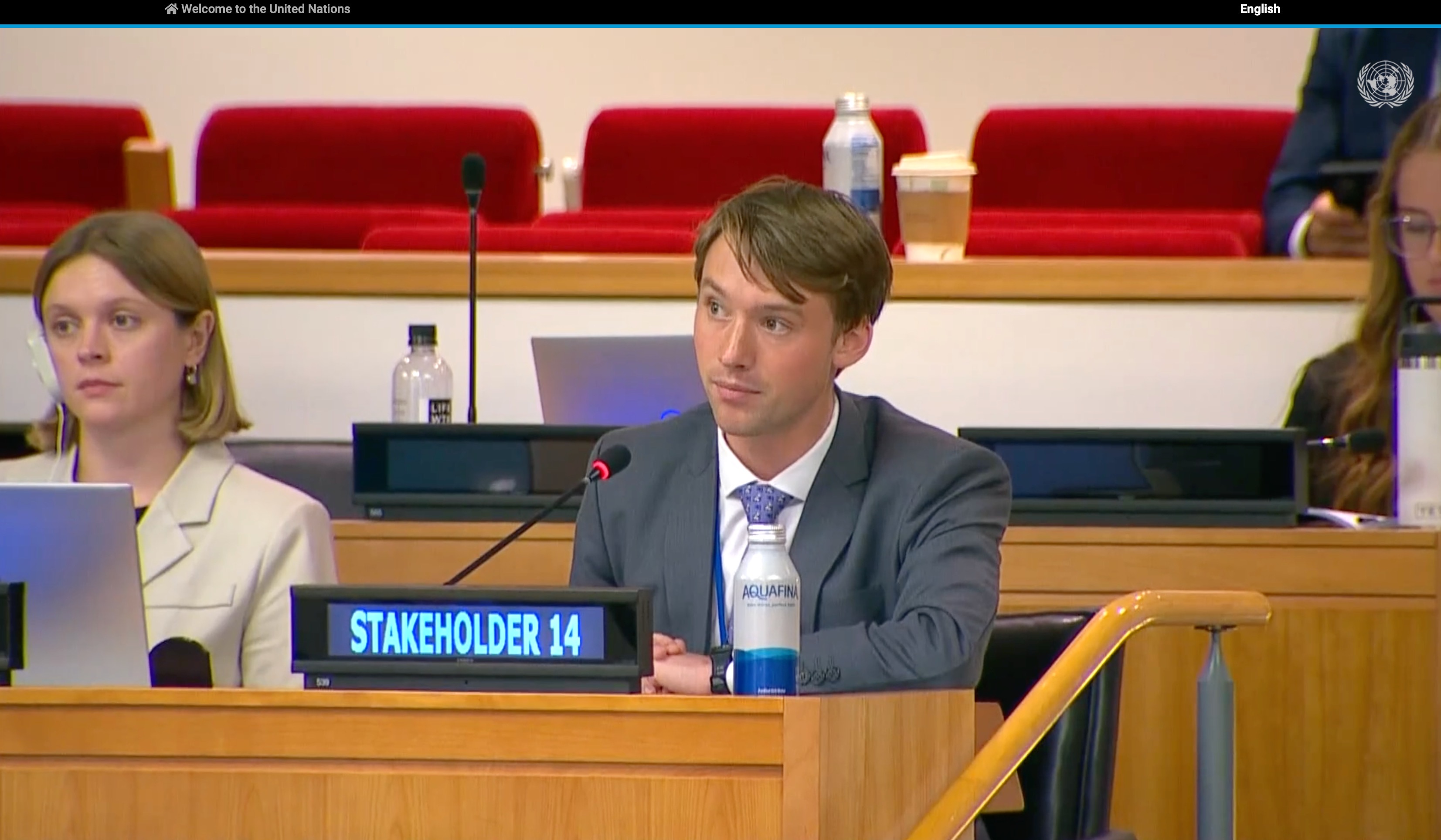
UN floor address & youth statement on ICTs

2023 NPT PrepCom · NAPF
Applied
+

Selected by peers to draft the youth statement for the 2023 Nuclear Non-Proliferation Treaty Preparatory Committee, and delivered the address on the role of information and communications technologies in security policy. Briefed parliamentarians and members of Congress on the AI–nuclear nexus throughout 2023.

Prepared speech materials for civil society partners and UN representatives, helping communicate policy positions on AI governance, emerging technologies, and international security in clear, public-facing language.

Impact

Venue
UN floor
Selected by
Youth delegation
Hosted
NAPF · RTT
Multilateral AI–nuclear nexus Disarmament ICT policy
№ 12
2023

Generative-AI use policy guidance for the Nuclear Age Peace Foundation

NAPF · Reverse the Trend
Applied
+

Researched the AI–nuclear nexus and produced internal-use policy guidance on organisational use of generative AI for the Nuclear Age Peace Foundation. The guidance covered acceptable use cases, governance considerations, and the boundary between research and operational deployment in a small-organisation context.

Spearheaded internal discussions with NAPF staff about implementing the guidance in day-to-day work.

Detail

For
NAPF · internal
Topic
Generative AI use
Year
2023
Generative AI Internal policy Civil society
№ 13
2022

Executive appointment orders & board pipeline

Office of the Governor · Colorado
Applied
+

Drafted executive appointment orders and governmental memos at the Office of Boards and Commissions; managed candidate pipeline across 12 active board vacancies, coordinating with appointees and agency staff on state-level operations.

Impact

Vacancies
12 active
Office
Boards & Commissions
Dates
May – Sep 2022
State government Appointments Operations
04 — About

A short orientation.

Grahm Gaydos

I grew up in Colorado, ran NCAA Cross Country and Track at Williams College, and got into policy work because I kept being struck by how often the gap between what governments said about technology and what they actually did came down to the unglamorous institutional infrastructure underneath—who could translate a regulation into an implementation memo, who shaped requirements before any meeting convened, and who had the institutional standing to make a recommendation stick. I went looking for the work where those gaps get closed, and I have spent the last few years doing just that-in Jefferson County, at the Westminster Foundation for Democracy, at the UN, and now at the Oxford Internet Institute.

I'm someone equally comfortable in a policy review, a stakeholder negotiation, or a research seminar, and can translate cleanly across all three. I write quickly and tightly—I would rather hand a team a five-page brief that lands than a fifty-page report nobody opens. I am comfortable telling leadership that a recommendation will not survive contact with the institution it has to operate inside, and equally comfortable redrafting it until it does. Outside of my work, I race professionally on the USA Triathlon National Development Team, with an aim towards qualification for the 2028 Olympic Games.

Open to fellowships, research roles, and policy positions—particularly with teams working on the institutional conditions of AI deployment.

Speaking at the UN
2023NPT PrepCom
Working at Oxford
2026OII
Triathlon race
2025NDT
Williams Graduation
2025NDT
Thinking Thoughtfully
2025NDT
At the Colorado Capitol
2025NDT
06 — Get in touch

Let's talk.

Open to fellowships, research roles, and policy positions in 2026—particularly with teams working on AI procurement, governance, or the institutional conditions of frontier AI deployment. Reasonably fast on email.